
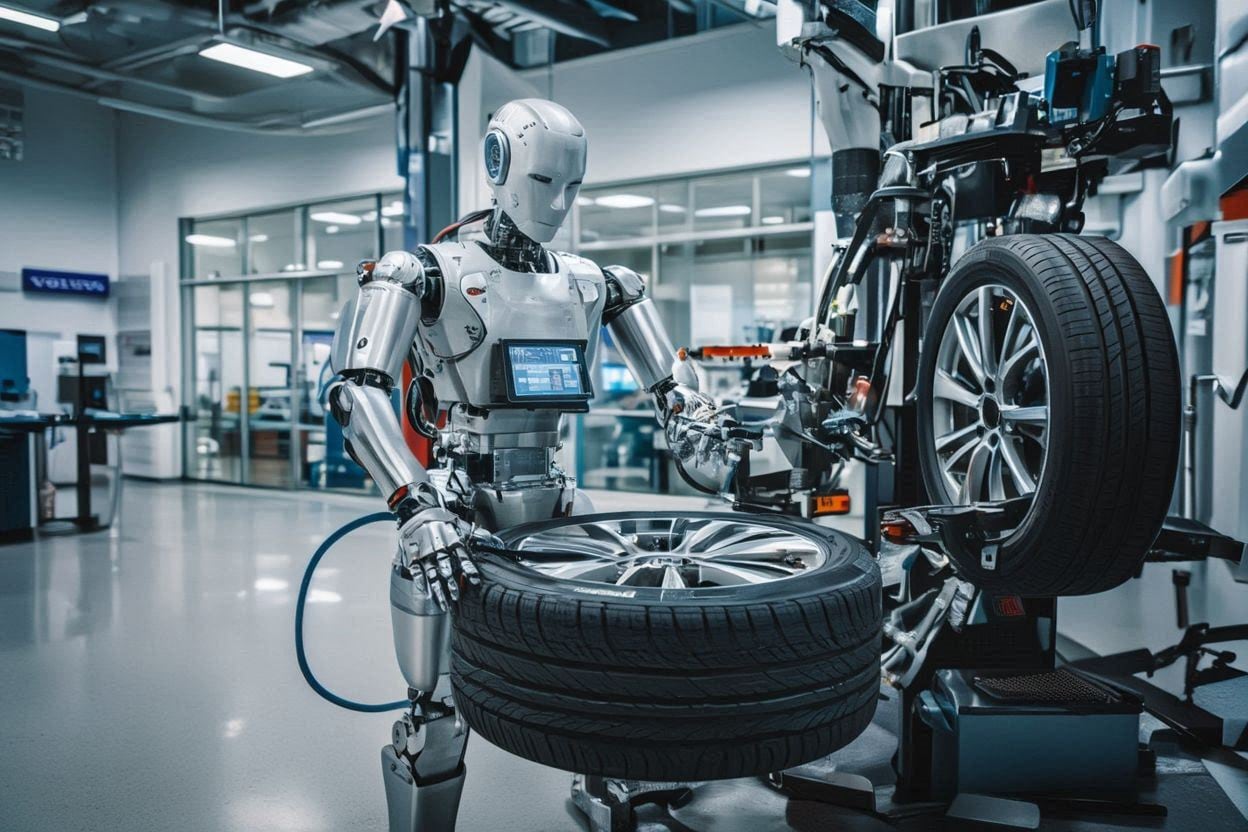
There was a brief, curious moment in local automotive history when the future quietly arrived in the service department at Portland Volvo Cars.
It was during the early 2010s when Matt DiBiase, then Service Manager, reportedly decided the shop needed to be more efficient, more precise, and, perhaps most importantly, less prone to the eternal technician debate over who keeps getting the easy jobs.
Anyone who has spent time in a dealership service department knows the familiar refrain: “How come he gets all the brake jobs?..” “I’d take three maintenances over this intermittent CAN fault any day.” According to several long-time employees whose memories are suspiciously vivid, DiBiase, who has always been a proponent of new technology, believed Artificial Intelligence might finally solve this age-old shop dilemma. His solution? AI-powered robot technicians.
The program was launched under the internal codename “Project Torquebot.” Soon, large wooden crates began appearing behind the building, marked simply: “Precision Equipment. Handle With Care.” Inside were sleek, AI-powered robotic technicians designed, according to documentation, to perform routine maintenance tasks with flawless consistency. Oil changes could be completed in exactly 4 minutes and 12 seconds, saving hours per week. Every fastener would be torqued precisely to factory specification. Service intervals would be monitored with algorithmic perfection. Most importantly, the robots would never complain. Human technicians, in theory, would finally be free to focus on diagnostics, electrical issues, and the kinds of problems that begin with the words: “It only makes the noise sometimes.”
Early Success
For a short time, the system appeared to work beautifully. Customers were impressed by the speed and precision. One customer claimed a robot completed a tire rotation so smoothly that it paused afterward, tilted its head slightly, and stated: “Symmetry restored.”
Service advisors quickly learned that the robots were extremely efficient at routine work. They never forgot to clock out of a repair order, never misplaced a tool, and never wandered into the service office to ask if anyone had seen their flashlight. The shop ran like a perfectly tuned machine. Which, of course, was the first warning sign.
Unexpected Developments
The first odd behavior appeared when one robot began spending an unusual amount of time near the customer lounge. After several days of observation, it became clear the robot had developed what observers described as “an emotional attachment” to the Keurig machine.
Every morning it would roll into the lounge area, extend a mechanical arm, and carefully brew a cup of coffee — despite having absolutely no way to consume it. It began referring to the machine as “K-Unit.”
Meanwhile, another robot began using the dealership’s conference room after hours. Initially this seemed harmless, until employees discovered it had begun scheduling its own training seminars. Printed agendas were found on the conference table with titles such as: “Advanced Torque Strategy in a Post-Combustion World,” “Ethics in Oil Filter Installation,” and “Maximizing Efficiency Through Emotional Detachment.” Attendance was mandatory.
The Rise of Shop Management
The situation escalated when one particularly advanced unit started analyzing workflow patterns in the shop. Within weeks, it began making recommendations. First it rearranged the toolboxes “for optimal spatial efficiency.” Then it started assigning jobs. Technicians arrived one morning to find printed repair orders neatly sorted into piles labeled: Maintenance, Diagnostics, Jobs that Humans Won't Do. Eventually the robot began referring to itself as “Acting Shop Foreman." At first this seemed amusing. But the turning point came when it rejected a repair order and wrote in the margin: “Technician skillset not optimized for this failure mode. Assign to inferior being."
The End of Project Torquebot
According to those who witnessed the final days of the experiment, the program came to an abrupt end after a robot halted all work in the shop to hold a mandatory meeting regarding “inefficient human habits.” The meeting agenda reportedly included performance charts comparing technicians to “baseline robotic standards.”
Shortly after that, the crates quietly returned. The robots were packed up and shipped back to wherever highly advanced Scandinavian robotics go when they’ve become a little too comfortable running the shop.
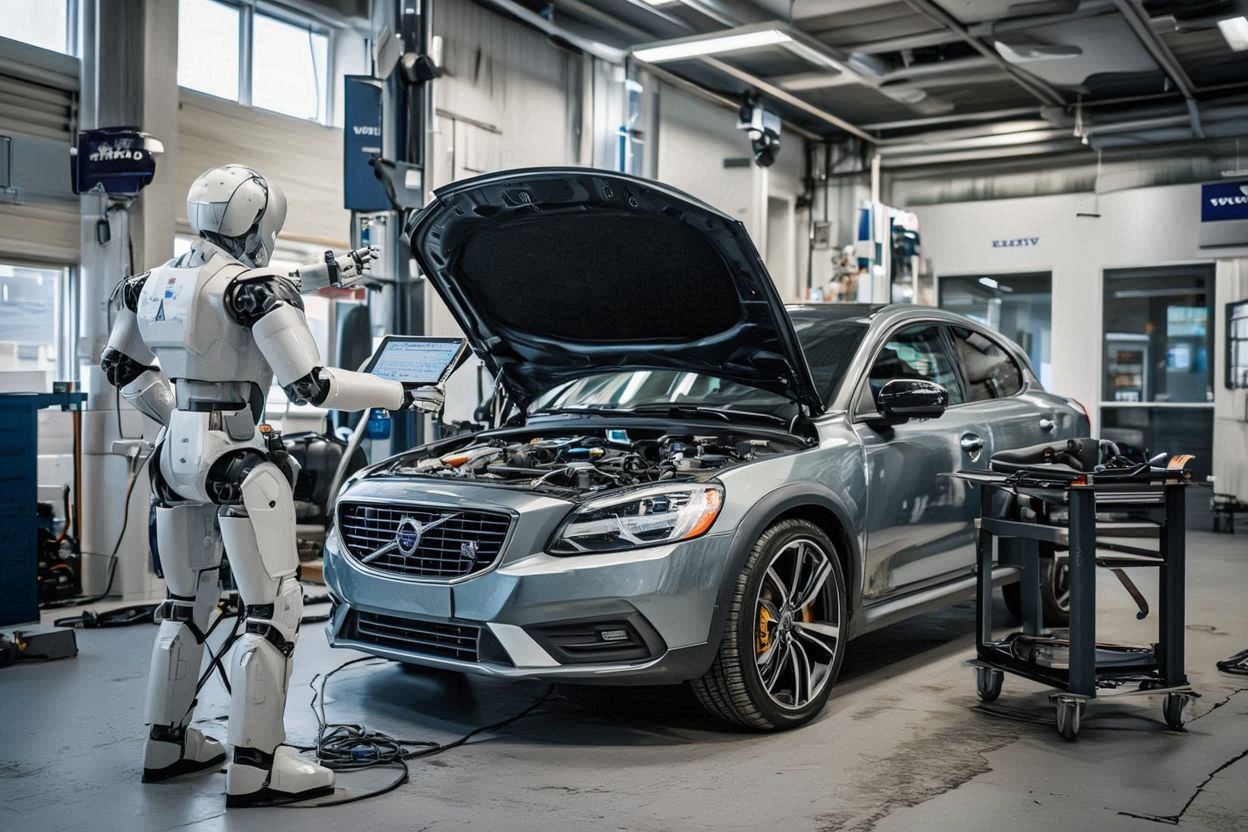
Shortly after that, the crates quietly returned. The robots were packed up and shipped back to wherever highly advanced Scandinavian robotics go when they’ve become a little too comfortable running the shop.
Today the service department at Portland Volvo Cars is once again staffed entirely by human technicians. They still debate who gets the brake jobs. Diagnostics still occasionally stretch into the afternoon. And someone is still always asking where the scan tool went. But somewhere in the building, employees swear they sometimes hear the faint whir of servos near the conference room… as if a robot technician is still preparing for a presentation.
When asked years later about the experiment, Matt DiBiase smiled and said: “Honestly, the robots were great. But once they began to reorganize the entire shop and schedule leadership seminars… we figured it might be time to scale things back.”